
- Europe and International + 33 1 81 69 16 01
- USA and Canada + 1 617 682 3624
What are TAL Effector Nucleases?
Transcription Activator-Like Effector Nucleases are the next generation tools for gene editing
Transcription activator-like effector nucleases are a novel class of sequence-specific nucleases, created by fusing a transcription activator-like effector (TALE) DNA binding domain to the catalytic head of an endonuclease (N).
TALEs are naturally-occurring transcription factors first discovered in the plant pathogen Xanthomonas, and are injected into the plant cell nucleus via the bacterial type III secretion pathway. In the nucleus, the factors bind specific sequences within gene promoters to modulate host resistance mechanisms. Each TALE contains a highly conserved central region consisting of varying numbers of repeat units, typically 33 to 35 amino acids, which give the TALE protein the ability to bind specific DNA sequences. These repeated regions are highly conserved with the exception of two variable amino acids at positions 12 and 13. These residues, termed the repeat-variable di-residues (RVDs), are responsible for the DNA-binding specificity of the repeat region. DNA recognition by TALEs is therefore based on a simple code whereby one RVD recognizes one nucleotide of DNA sequence and ensures that the DNA binding domain of each TALE can target large recognition sites with high precision (15 - 30nt).
Cellectis bioresearch’s TALEN™ recognizes a DNA sequence of two sets of 17 nucleotides, which is the average number of RVDs for naturally occurring TALEs.
The second component of a TAL effector nuclease is the catalytic domain of an endonuclease that introduces DNA double-strand breaks (DSBs) in vitro and in vivo, and which is fused to the TALE DNA-binding domain.
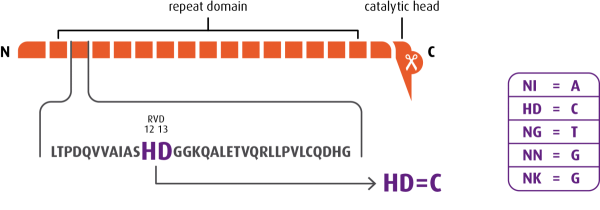
The next generation of sequence-specific nucleases is created by the fusion of a Transcription Activator-Like Effector (TALE) domain and the catalytic domain of an endonuclease. The TALE domain contains a repeat region, which is composed of repeats containing the repeat variable di-residue (RVD). RVD binds DNA specific respecting code.
Cellectis bioresearch’s TALEN™ is therefore a heterodimer composed of two highly sequence-specific TAL effector nuclease units. These units bind target DNA sequences and create a spacer region to allow the endonuclease domains to dimerize and create a double-strand break. Following DNA cleavage at a user-specified site, the process uses one of two highly conserved cellular processes to repair the double-strand break, enabling a full-range of gene editing applications: homologous recombination or non homologous end-joining.
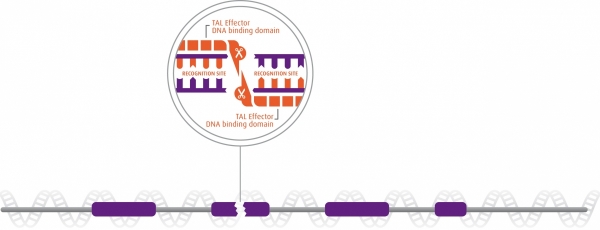
TALEN™ binds to DNA target and induces DNA double-strand breaks